
Advanced Interface Prototyping
Mar - Jun 2026
Collaborators
Nhi Nguyen
Niann Lu
Key Skills
Ideation, Futures Thinking, Concept Mapping, Storyboard, Desktop Walkthrough
Over the course of 8 weeks, I worked with my teammates on a futures-driven design project, exploring the professional and systemic barriers that freelance illustrators may face and building tools to help them navigate what's ahead.

Futures & drivers research
I worked on envisioning a landscape for illustrators in 2030 by identifying emerging forces from cultural, economic, and technological lenses.

XR proposal & design challenges
During Assignment 2, I focused on developing an XR solution to enhance client communications for illustrators.

Voiceflow development & testing
For Assignment 3, I focused on iterating the chatbot based on my teammate's research, shaping nuances into the conversation.
PROBLEM DISCOVERY PROCESS
Empowering illustrators by filling in the knowledge gap
As an illustrator myself, I have seen firsthand how the AI wave has affected the industry. But the core problem was that freelance illustrators have always been under-equipped when it comes to understanding their own rights and legal processes. AI exposed this gap and made it an undeniably urgent problem to resolve.

Therefore I thought, how do we get illustrators to act with more confidence and initiate possible legal action when dealing with cases like:
inappropriate AI use
starting a new project and drafting an agreement
liaising with commercial parties
artwork used without credit
out-of-scope client revision requests
and more…
INDIVIDUAL CONTRIBUTION HIGHLIGHTS
Starting with what I already know
My research for drivers of change started from lived experience. As a working illustrator, I have already been paying attention to how the industry was shifting.
VGen, a commission platform that brands itself heavily on non-AI policies, was one of the first signals that came into mind. A platform with its entire identity around being human-first revealed the rising demand for proven authenticity in illustration.
VGen has been a huge success since launch and is highly regarded by artists due to its strict non-AI policy & marketing, showing that illustrators are actively seeking platforms that protect and advocate for their work.
Glaze and Nightshade: tools built to protect artistic style from AI training data

PERSONAL REFLECTION
In retrospect, I could have considered more future scenarios that exists independent of AI for the first assignment. Our team realised this when brainstorming for XR and Service Design proposals - that there were many design opportunities outside of the copyright dilemma that we've been focusing on, such as improving working conditions and encouraging the general population's deeper engagement/appreciation for art.
But grounding the team early in the top pressure facing the freelance illustration market was still helpful as it allowed us to delve into insightful details about the current presence of AI in this space.
INDIVIDUAL CONTRIBUTION HIGHLIGHTS
Making Arta feel like someone worth talking to
I led the development of Arta in Voiceflow from mapping the core conversation flows to stress-testing them against the messier, more realistic scenarios users might actually bring. The most challenging part was definitely tone and contextual sensitivity.
I constructed the primary conversation architecture and compared the impact of using Playbooks with Knowledge Base vs. Workflows for different branches.
Notably, a LOT of finetuning was required to keep Arta's voice consistent across three branches. I ran comparative testing to land on the tone that felt most trustworthy to a creative audience, adding personal touches such as textmojis and slangs to make the tool feel more down-to-earth and accessible without losing the authenticity.

I also built out edge cases based on what my teammates have considered against analytical lenses for human centered design of Agentic AI:
What happens when a user's artistic domain is out of scope for ARTA?
When they're requesting legal action from ARTA on their behalf?
What if they're providing personal information input?
What if they don't want to proceed anymore?

This is where I found limiting for voiceflow - the tool being low-code, beginner-friendly meant that it sometimes lacked precision and consistency. Sometimes the tool would be giving comprehensive introductions, sometimes it's just a simple "Hey I'm ARTA. I can help you with XYZ". I had to tweak my phrasing of instructions given to voiceflow and make emphasised sections like #IMPORTANT - READ THIS FIRST to highlight specific actions. Otherwise, voiceflow ignores them.
As someone using voiceflow the first time, I find that I often have to resort to other AI tools to debug, as voiceflow gave limiting advice on what exactly is causing a specific undesired output. I also found it difficult to keep track of contradictory responses as I iterate on how I phrase different sections. But overall, it felt quite rewarding to be able to "code" up an AI chatbot with constraints like cost and time.
AI REFLECTIONS
Being intentional about AI usage in my design process
Throughout the project, I leveraged AI to expand on existing ideas and debug solutions. The core approach I took was using AI for breadth, not critical judgment.
I found that AI added great value when…
I want to broaden the brainstorm scope and step outside of the box.
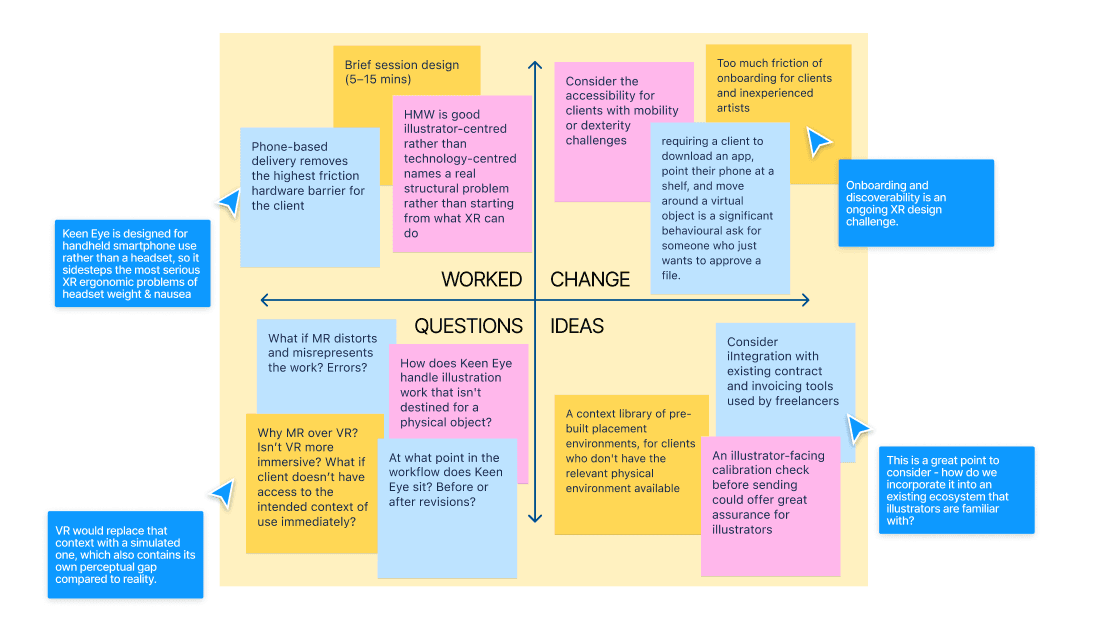
Using AI was effective when I am trying to surface different directions that I might have not yet considered. For example, based on the XR and Service Design ideas we wrote down in class on sticky notes, I asked AI to expand this idea portfolio by suggesting whether there are additional perspectives/opportunities that are not yet considered in here.
The intention is that AI will expand the breadth of ideas, but critical evaluation of output remained a human task. I went through each response one by one and critically considered whether they're appropriate and relevant, before putting it into my own words.
Developing & debugging in an unfamiliar system (Voiceflow)
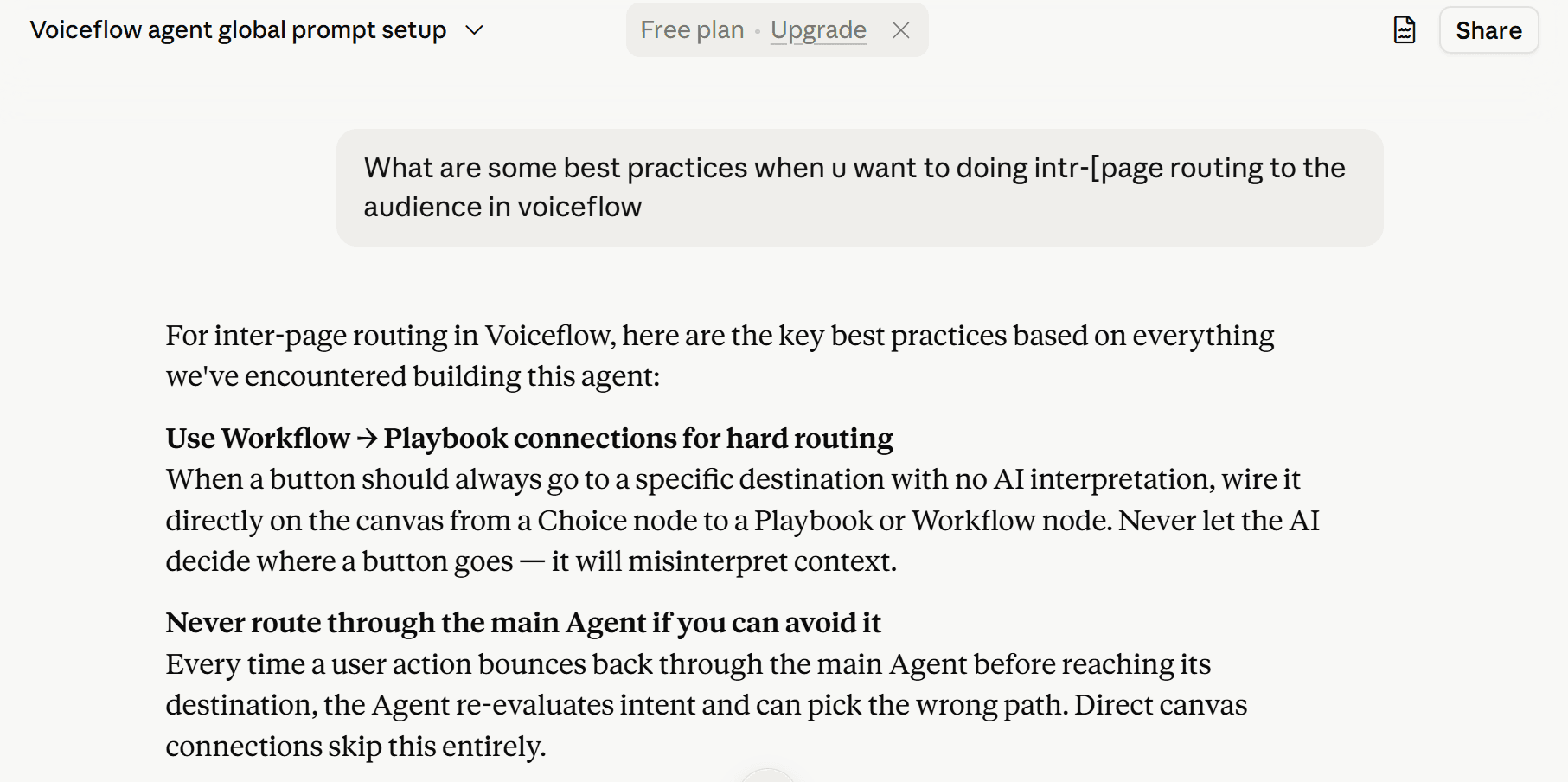
Throughout voiceflow development, I relied on AI to explain parts from voiceflow manuals that I didn't understand, and check my understanding. The most helpful use case was debugging - AI can assess why a playbook routing might break and suggest alternative ways to improve the written instruction.
However, there also contradictory or unhelpful advice, and the output must be carefully evaluated before putting to use - frustratingly, AI will make unannounced changes to code blocks, reverting previous fixes to what it prefers.
More importantly, AI lacks context about the prototype's specific constraints, and it can still respond with apparent confidence that makes people fall into the trap of blindly accepting its 'fixes'.
Where AI required caution…
Contradictory advice in technical contexts
When AI gave conflicting Voiceflow guidance, it became unhelpful and even dangerous to rely on.
For example, I was struggling to get Voiceflow to route to the right Playbook, pulling from the right knowledge base (instead of general AI), and rather than analysing potential cause of error, Claude gave up and tried to explain this as a 'typical voiceflow capability issue'. Eventually, I looked up documentations and switched this conversation flow to a Workflow instead of Playbook.

Generating Fluff
This is definitely a signature AI behaviour. AI writes fluently but lacks contextual awareness of what I am working on. Therefore the output always end up with generic, long paragraphs that lack real value.
There's always a temptation to accept well-structured AI text without critically asking: Does this really reflect what I am trying to communicate? It always requires critical thinking and discipline, and AI outputs should be treated as supplementary draft materials for consideration, not direct inclusion.
Lack of control on creative outputs
Another example to note is the use of AI to generate Artefacts From the Future. I found that despite being extremely time-efficient to generate, it is missing important details and lacks the flexibility to be modified or expanded upon.
Instead, every new prompt re-generates a different artefact based on AI interpretation - a black box that we cannot see.
[See image below: version 1 of artefact, version 2 of artefact]


PROCESS REFLECTION
What iterative prototyping taught me

The subject taught me two things: First, how to remain open about changes and detours during the design process; Second, presenting and framing your work strategically for the right audience is as important as having a great design.
Throughout the iterative prototyping process, we presented our work to peers and teaching staff for feedback, who have limited contextual understanding of our problem space. This was an interesting challenge and got me into the habit of being mindful of stakeholder's understanding and setting the context right so that everyone is aligned.
One key learning was that prototypes are questions, not answers. The shift that changed my work ethic most was releasing the instinct to defend early decisions. Being open to change and not falling in love with the first idea is something I am actively trying to practice. For example, in assignment 2 we had to evaluate the top proposal out of the three we had produced, and this was a hard moment to give up on my idea (and say no to others' too).
I thoroughly enjoyed the peer feedback component and felt that it widened our perspective and prompted us to think outside the box. I particularly loved hearing the thoughts from an outsider's POV and also got to improve my feedback facilitation skills - critical going into the workplace.
Declaration of AI Use
I acknowledge the use of AI, including Claude Sonnet 4.6, to support the preparation of this portfolio. It was used to debug Framer layout errors and brainstorm effective ways to structure the content in a way that's easy to read. It was not used to generate any written content on this portfolio.
THANK YOU FOR READING!